
The 45-second version
Problem, ownership, response, and outcome
- Problem
- Compliance research can produce fluent reports before the underlying scope and evidence are reliable.
- What I owned
- Product framing, release decisions, the scope-first direction and v0.7 specification, evaluation, and the trust standard—with AI-assisted implementation under my review.
- Product response
- A four-stage scope → research → analysis → review pipeline with provenance and explicit missing evidence.
- What changed
- The failed audit stopped v0.6 and moved accuracy, traceability, and refusal behavior ahead of new features. v0.7 later shipped with known limits disclosed.
- Boundary
- Decision support only. It does not determine legal applicability, establish compliance, or replace counsel.
The user and stakes
Small teams need orientation—not an automated verdict.
An AI startup can face product, privacy, professional, sector, and jurisdictional obligations before it can hire a dedicated compliance function. The immediate need is practical: identify which questions may matter, see the assumptions behind them, and know what to verify with a qualified expert.
The risk is asymmetric. A missing result is inconvenient; a polished but misattributed obligation can redirect product work, create false confidence, or turn weak research into a high-stakes decision. The product therefore has to optimize for defensibility before completeness.
The release decision
The audit failed—and that became the most valuable result.
An early version searched the web and asked a strong reasoning model to assemble a report. The output became more complete and more convincing, but the research feeding it was still inconsistent.
I put two reports generated from the same input through a seven-claim audit. Four claims were wrong or misattributed: a superseded deadline reported as passed, a professional-body quote traced to a training company’s blog, a wrong state-law effective date, and a regulation applied outside its scope. A separate six-run check exposed three incompatible answers to the same vendor-retention question. The problem was not one bad citation; the system could tell different stories with the same confidence.
I held v0.6 back—never tagged, deployed, or delivered. Then I asked the product question that changed the architecture: how can search know what counts as authoritative before the system has scoped the regulatory territory? That shifted the workflow from search-first generation to scope-first research.
In a trust product, a persuasive answer without defensible evidence is a product failure—not a formatting problem.
What I actually did
My role and decision authority
As founder and sole product owner, I use an AI coding agent as an implementation partner. I set product direction, wrote the v0.7 build specification, approved design choices before code, reviewed the build, ran the tests, challenged the output, and owned the release decisions.
Trust, translated
The decisions that changed the product
From decision to system
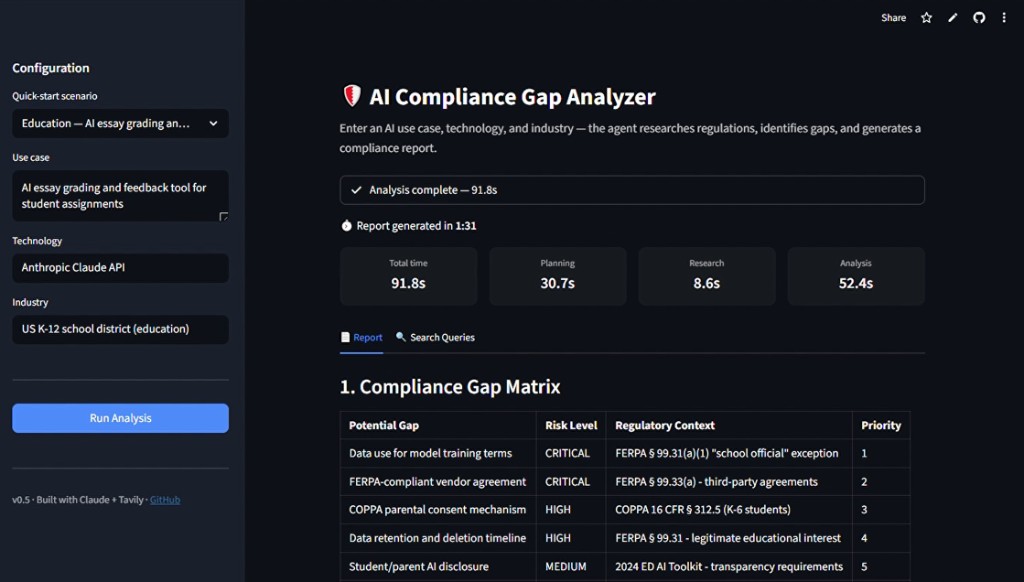
A working four-stage research pipeline
The current implementation uses Python, Streamlit, Claude, Tavily, Supabase, and Langfuse. It runs live web research and saves traceable report artifacts; it does not use a vector database or production RAG index.
- 01
Scope
Translate the use case, technology, industry, and location into structured assumptions, candidate regimes, and official domains across five dimensions.
- 02
Research
Run live searches for each candidate regime, trying official domains first and retaining every query, URL, source tier, and regime label.
- 03
Analyze
Generate a structured seven-section analysis from the scoping context and retrieved evidence rather than relying on model memory alone.
- 04
Report and review
Surface the analysis, assumptions, coverage, sources, and executed queries separately so a human can verify any decision they act on.
Working or demonstrated
- Structured scoping across five applicability dimensions
- Official-domain-first search with a broader fallback
- Source and query visibility in the generated report
- Empty-research refusal and mandatory review boundaries
- Run ID correlation across reports, traces, records, errors, and tests
Not production-ready
- Deterministic verification that a returned URL really belongs to the claimed official source tier
- Claim-level binding between every material statement and a specific citation
- Stable, testable prioritization and multi-scenario regression evaluation
- Complete authentication, access, consent, retention, and deletion controls
What the evidence says
The redesign improved honesty—not certainty.
Two small evaluations are kept separate: a seven-claim correctness audit across two v0.6 runs, and an identical-input comparison of six v0.6 runs with three v0.7 reruns on one anonymized professional-services scenario. These are directional product tests—not an accuracy rate.
The new sequence improved coverage and consistency in a small repeated test. It also revealed defects that still block a stronger release claim.
- 4 / 7
- claims in the two-run v0.6 audit wrong or misattributed
- 3 / 3
- v0.7 reruns surfaced the governing body
- 3 / 3
- v0.7 reruns disclosed assumptions
- 1 / 3
- v0.7 reruns still repeated a stale deadline
- The governing professional body was absent from the findings in two of six v0.6 runs; in all three v0.7 reruns it was present and cited to its own domain.
- Across six v0.6 runs, the tool asserted three mutually incompatible vendor-retention answers. All three v0.7 reruns instead said the terms were not found and recommended obtaining them directly.
- One lower-quality source still leaked into the official-source tier, and priority ranking varied across identical inputs.
- Every logged v0.7 run so far (seven across three scenarios) took 2.5–3.0 minutes end to end; v0.6 took 1.8–2.2 minutes on the comparison scenario.
- Separately, I personally checked 33 source links in an AI-assisted deliverable: 29 verified, one dead government link found and replaced, and three left unresolved. This was a human verification pass—not automated-pipeline validation.
Outcome and impact
I stopped one version—and shipped the next with its limits visible.
v0.6 was misleading: its errors sounded more certain than its evidence. I held it entirely. v0.7 was still incomplete, but the product made scope, sources, assumptions, and missing evidence visible. I shipped it as a research prototype with tier leakage, ranking drift, and the stale-deadline recurrence documented in the release notes rather than hidden.
This work has not yet produced verified customer, legal, or compliance outcomes. Its current impact is product judgment made operational: one version stopped, an architecture changed, and the next trust gates made measurable.
- Decision impact
- v0.6 withheld: untagged, undeployed, undelivered
- Product impact
- scope-first v0.7 shipped with limits disclosed
- Trust mechanism
- missing evidence stays visible
- Next gate
- deterministic source and claim validation
Current boundary
What this work does not establish
- This is a research prototype, not legal advice or a compliance determination.
- Live web search remains vulnerable to source churn, ranking instability, and temporal errors.
- The system does not yet have a curated regulatory knowledge base, production RAG layer, or automated citation checks.
- The prototype’s automated outputs have not been validated against expert-authored compliance analyses.
The next honest release
What I would build next
Reflection
The defining product decision was not how to make the report sound smarter. It was how to stop the system from sounding more certain than its evidence. Trust is earned when a product is willing to reveal the limit that makes its own headline less impressive.